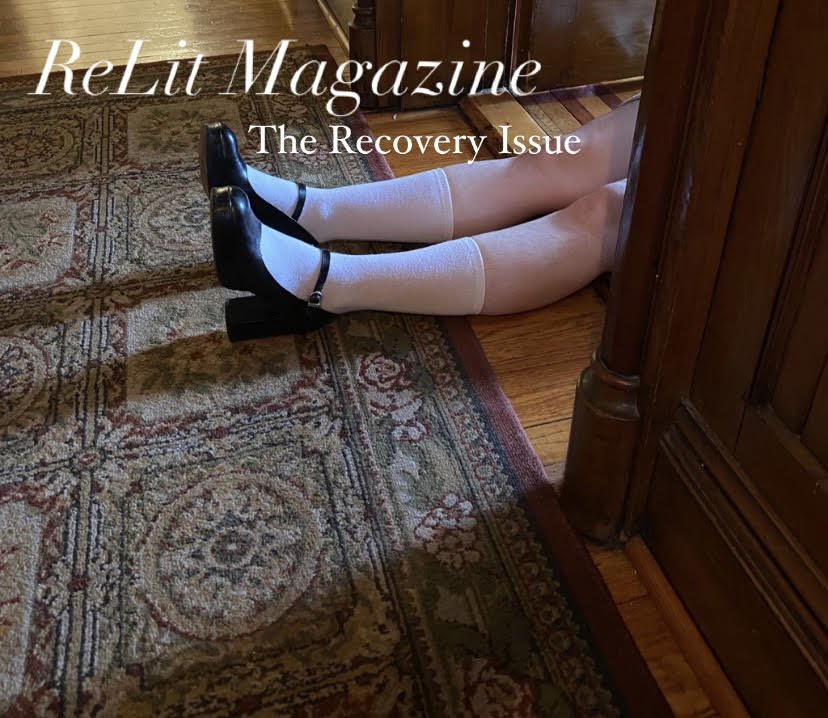
ReLit Magazine: The Recovery Issue
edited / cover art by Katherine Alexandra Harvey
Table of Contents:
Lift - Brooke Lockyer (short fiction)
Interview with ReLit Awards Founder, Kenneth J. Harvey
Swallowing Grief, A Methodology - Daze Jefferies (visual art + poetry)
Cult Life: Spotlight on ReLit Awards Shortlistee, Kyeren Regehr
Excerpt from upcoming novel, I am Billy the Kid - Michael Blouin
Aregulars, Foldku, Blank, The Middle Is in the End - Daniel Scott Tysdal (poetry)
Snapshots of Her - Cassandra Blanchard (poetry)
Excerpt from upcoming novel I Gloria, Grahame - Sky Gilbert
——————————————————————————————————————————————
Lift
Brooke Lockyer
A man opens my mother’s face with a knife. The knife enters the skin just inside her left ear, the blade carving along her hairline like a figure skate making its cold loop on the ice. The man nestles new cheeks beneath her skin. He pulls her eyes taut with precise, little stitches. When she heals, she will look surprised forever.
There isn’t any blood when I imagine the knife entering her face, just the submission of skin, parting like the teeth of my suitcase zipper when I’ve pulled the tab. Whenever she mentions the “bit of work” she’s booked, I focus on these safe, bloodless images, on my mother’s reassuring smile. But when I sleep, doctored versions of her limp towards me.
“You’re so dramatic,” sighs Mom as she brushes her newly blond hair. “People do this every day.”
I’ve been having trouble falling asleep at my parents’ house lately. I listen to Mom toss and turn and wonder if she can hear me toss and turn. Is she waiting for Dad to come back from the bathroom, mouth minty with toothpaste? Does she curl up and try not to think of his dark suits swaying in the closet behind the door, the tongues of his leather shoes thickening with dust? Does she imagine the doctor erasing the lines Dad’s sudden death left on her face?
When I watch Mom make the bed, I imagine the surgeon lifting the flap of her skin with his gloved fingers, flicking his wrist the way she's snapping her sheets in the air to unwrinkle them. I envision him carefully draping her smoothed skin over the bones of her nose and the holes of her eyes, tucking the edges back into her hairline before stitching her up.
“Don’t do it,” I burst out.
She turns her head to look at me, smiles. “I need something to pick me up,” she says. “It will just look like I got a really good facial.” She plumps a pillow, wags a finger. “You better not tell anyone.”
I memorize the lines on her olive-skinned face when she’s not paying attention. My eyes linger on the furrow between her dark eyebrows, the wrinkles punctuating her cupid’s bow mouth. I always wanted to look like her, used to wet my hair so it appeared as black as hers, sucked in my waist so it was almost as tiny, smeared her Chanel red on my lips. People always said I took after Dad, though, square-jawed with easily burnt skin. But under my hair hide Mom’s small ears, and in photographs I’ve seen her grin flash-frozen on my face.
When they were together, my parents had been careful with their health. They never drank more than two glasses of wine, refused sugar in their coffee, exercised regularly, and always reapplied sunscreen after swimming. They had therefore always seen themselves immune to illness and infirmity. They’d believed that they deserved to welcome death on their own terms. Centenarian bodies intertwined in soft slumber, holding hands as the light grew brighter.
“How could he leave us?” Mom fumes on the way to Toronto, where the plastic surgeon and I both reside. “I’m furious with him.”
I’m angry at the man with the knife, and at Mom for falling for his promises. I found his beige face and matching toupee online, surrounded by promises of regeneration and change.
I don’t think Mom wants to know what plastic surgeons actually do when they perform facelifts. I can’t bring myself to research the details either, but I’m pretty sure it’s no spa treatment. When she met with the doctor a few months ago, clutching photos of herself in younger days, he nodded at them and showed her “before” and “after” images of his patients in a heavy, bound book. I picture her flipping through the pages, watching creases disappear between eyebrows and the corners of mouths, wanting to become an image of an earlier self, one not yet marked by time.
I think of Dad’s smooth headstone at the engravers’ office. I think of the dirt hardening over the hole where we lowered him, the grass growing in. “I’m still deciding on the design,” she said the last time I asked her about it, as we were making dinner in the kitchen. She burst out crying, an egg breaking in her hand. “I’m not ready,” she said, as she stood with her arms pinned to her sides, the yolk dripping on the floor.
“Hug me,” she said quietly. I wrapped my arms around her. Her body was small and cold and shaking. I hugged her as hard as I could, but it didn’t feel like a hug without her squeezing me back.
“Annabel had some work done,” Mom says now, as she turns into Tim Horton’s drive-through. “I bet you didn’t know that.”
“Annabel looks like she escaped from Madame Tussauds.”
“I’ve decided,” she says in a tight voice. “So you’re just going to have to get used to it.”
After it’s over, she stays in a quaint Yorkville hotel to recuperate. I take the subway to visit her, and we talk from opposite sides of the door, grasping each other’s hands through the newspaper slot. Sometimes she cries. Sometimes I do.
“I miss Dad.”
“How do you think I feel?”
“I know, I’m just saying.”
“I look like a mummy,” she says. “With a drainage tube.”
When she needs to rest, I give her hand a squeeze and tell her there’s a cup of lukewarm coffee waiting outside her door.
“I don’t want you to see me like this,” she says. “I’ll count down from 10 before I open the door. When I hit one, you better be gone.” Her fingers retreat into the hotel room.
A few weeks later, my aunts and I are at the Art Gallery of Ontario to see her. A woman stares at me from across the lobby. She stumbles towards us and stretches out her arms. Her eyes are the shape of slivered almonds, and up close I can see that the right one is oozing. Her skin looks grey and shiny, like shellacked clay. The stranger opens her mouth and my mom’s voice flies out. She pats my hair as she hugs me, says my name.
“Doesn’t she look great,” exclaims Aunt Genevieve, as if it wasn’t a question. “Like a Thanksgiving turkey, the meat basted, all shook down!” Aunt Rhonda laughs, says “Oh Ginny!”
“I’m full of pressure,” the woman says softly, pressing the top of her head with one hand. “I’ll never do this again.”
“Why would you,” says Aunt Genevieve, “you just had it done.”
I stare at the woman, at the ways she is and isn’t my mother. I wonder if her nose always had such a sharp upturn, if her ears used to sit a little further down on her head, if time will give her back her real eyes.
She reaches out to grab my hand, a tiny smile nudging against the smooth surface of her face.
I look down at the hundreds of lines on our palms and try not to think of the way Dad looked at the funeral, his features arranged by a stranger’s hand.
————-——————————————————————————————————————-
Katherine Alexandra Harvey interviews ReLit Awards Founder, Kenneth J. Harvey
Why did you start the ReLit Awards?
Before the ReLit Awards, the major publishers were claiming almost all the spots on the literary awards, particularly the Giller Prize. It was dominated by big press books. And the winner was always from a big press. Smaller, literary publishers never made the longlists. Plus the focus seemed to turn to prize money, big bucks, and shift away from the core values of craft and ideas. That's why I came up with the ReLits and its slogan: Ideas, Not Money.
What was your biggest struggle with the awards over the years?
Raising money to keep the ReLit rings going. It is always a challenge. Fortunately, we have had some very generous sponsors over the years. But, again, we are now in a position with no sponsor.
How do you feel about the current state of the publishing / literary industry in Canada?
It is in dreadful shape, mostly due to the monopolization of the industry by the multinationals. Every book must now make money with the larger presses. They're not interested in building careers like they used to do. The more commercial books helped pay for the more literary books, so there was a well-rounded stable of writers at publishers. That structure of generosity and encouragement has vanished. The smaller presses are still active and producing wonderful books by new authors, which is encouraging.
What would be your advice to the independent presses of Canada?
Be adept at marketing, particularly with social media platforms, and promoting your books. I was one of the first authors to have a website for promoting my books. It was at a time when an author was considered a shameless self-promoter, a sell-out and publicity hound if they had their own website. Writing is only part of the job. Getting the book in the hands of readers is another, just as important, part of the venture.
Are you still writing?
I stopped writing books around ten years ago because I became disillusioned with the industry, for the reasons already stated. Plus few value and embrace innovation. Most (but not all) publishers want the same book over and over... formulas. I also became tired of continuously trying to capture the nuances of expression and conversation on paper. Translating reality into words. It is an exhausting mindset to live with for so many decades. Having said that, I do miss writing books, and I am working on a novel that should be finished in the next couple of years. It is a difficult job to leave behind, despite the torment.
Why did you choose now to pass the awards on, and what do you think the future of the awards will be?
I ran the awards for 20 years. I did my part. It is a sometimes overwhelming amount of work each year. But it makes me extremely happy to know that the awards are staying alive in the family, and are in the hands of my daughter, Katherine, a writer with such tremendous talent and keen literary vision attuned to innovation.
——————————————————————————————————————————-
Swallowing Grief, A Methodology
Daze Jefferies
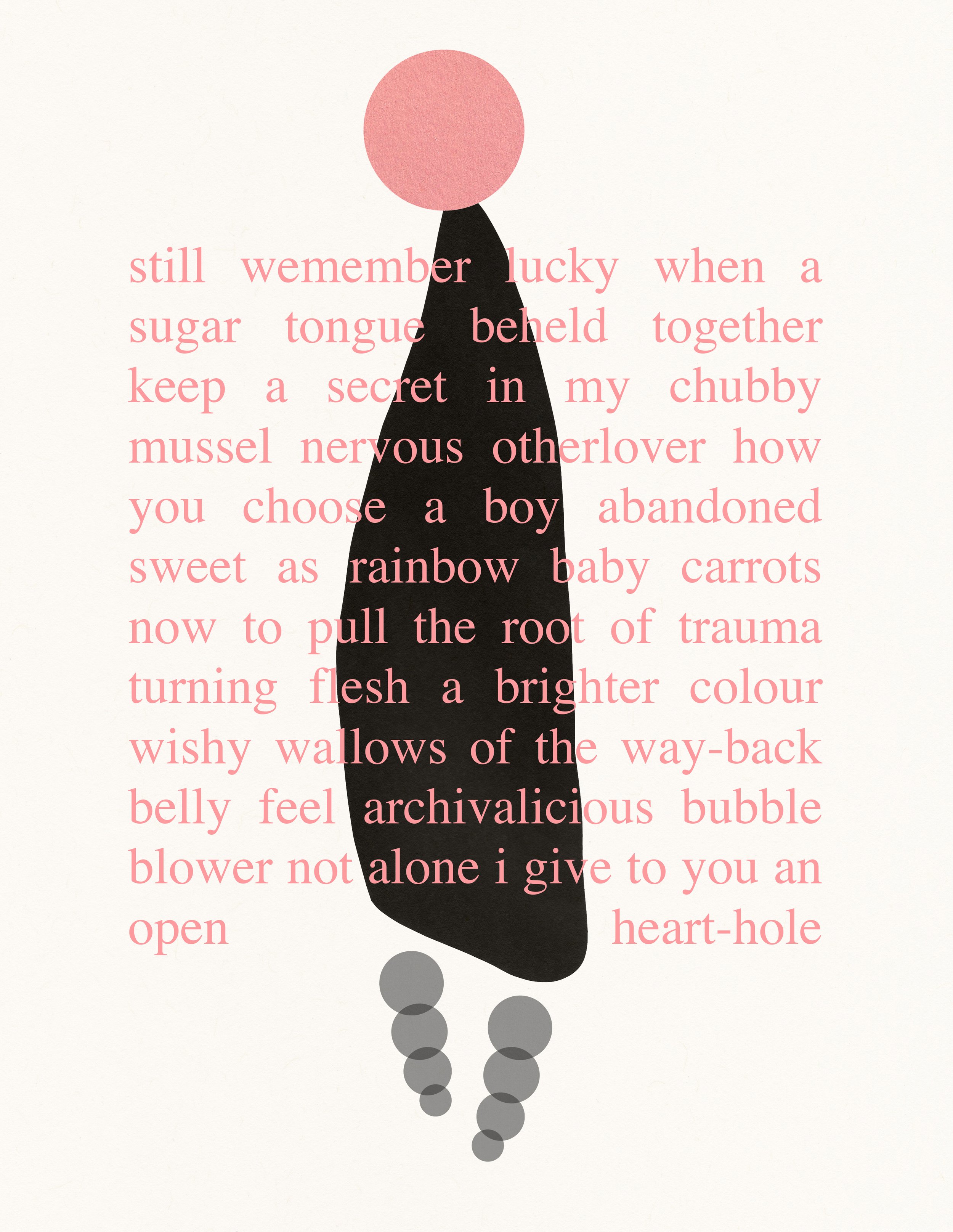
Bleed Becumming Ocean
KNOWING NO MORE ABOUT WHY YOU SPEND A LOST FOREVER / ON THE TOILET
LIKING EVERY HARD AND SKINNY T-GIRL SELFIE / YES KING I HACKED INTO YR
INSTAGRAM AGAIN / HAVEN’T SENT YOU ONE IN MONTHS / ALMOST ACHING TO
FEEL LOVE UNTANGLED / WHAT THE HARBOUR SWALLOWS ISN’T ANY OF MY
BUSINESS / JUST OBSCURA AND YR SYNDROME AND A BROKEN BODY FOLDED
BACK / TO ME UR BUT A MESSY LITTLE BOY / YOUNG BLEED BECUMMING OCEAN
WASTE / ANOTHER TOY OF TWO-HOLED MISTRESS / WITH HER TRAUMA PROMISE
PUSHING ALL THIS GAY GUILT OUT OF HERE / WHO BY A BOTTOM’S HAND WILL
STILL RECOVER / IN THE GUEST BATHROOM SOBBING SNOT INTO A TOWEL / NOW
MY HURT IS QUIET
Ghostmother Underwater
i. a silence that signals it is my turn to listen from afar floods hard and immoral.
ii. ghostmother underwater, why have you forsaken us wayward in the atlantic churning?
iii. grey-green dots take me farther from the east and i just can’t throw a lifeway together.
iv. blue, blue woman in ancient lavation – all you ever wanted was to be a broken heartist.
v. my wish: that we could keep working on us, both of us trying to work on us.
—————————————————————————————————
Cult Life: Spotlight on ReLit Awards Shortlistee, Kyeren Regehr (published by Pedlar Press)
After making found poems from His words
you find yourself using what He taught—how to catch
slippery thoughts, the slick ones flashing past like bronze
scale under pondweed. Is He speaking to you when He writes
You’ll never be satisfied being a poet. He’s dead.
You don’t recall reading that. Is it meant for you now? Dead,
for Chrissakes. Dead. All mind is eternal. His words
are like carpenter ants tunnelling your drift wood brain—
people never get rid of ants. You flip through His book,
scanning for phrases beginning I am, stealing
what follows for a poem, but His words suck you in
like a kiss: Haven’t you ever been so in love
you couldn’t stand it? Just wanted to savour this incredible ecstatic
annihilation...You stop yourself
quoting the next half-page on love. He was a magician
tugging scarves from his fist. Time is a sleight of hand.
Knots blur into a single cloth. Mind is sui generis. The cloth flies
out of His ear. He’s pouring milk into a newspaper funnel.
Any reasonable mind can see the absurdity
of physical reality. A milky dove swoops into the rafters.
He’s about to saw a woman in half.
He’s about to make you disappear.
Cult Life II
i. The day after they aired “Ashram or Cult” on the local
network, The Master drove down to the five-and-dime Himself, bought a
crate of grape Kool-Aid. They served it in the dining hall to whoops of
laughter and glee. We did have a couple of suicides, a few ended up in
psych wards. There was that twenty-something German guy who went
catatonic. But they all missed the teaching—they didn’t get it.
ii. How do people end up in a New Religious Movement? Jungians would
probably see it, collective consciousness and all. Minds are joined.
People get excited, zealous, think Beatlemania, think women racing the
streets burning bras, Canadian hockey riots. But it’s more than that, it’s
organized ecstasy—a rave DJ working the crowd into frenzy, the revival
hall with full gospel choir and folks dropping in the aisles. It’s a mass UFO
sighting over Mexico City— suddenly everyone thinks they know what’s
going on.
iii. People who died were scorned for leaving their bodies
behind—they weren’t fully devoted. The whole teaching is you
disappear from the world entirely, those who aren’t with us are dead.
The whole teaching is you’re not a body. There is no world.
iv. You can fall in fondness with anyone when you’re in the ditch
together—it’s that trench sense of camaraderie, it’s reflexive oneness, it’s
what necessitates prayer. Unless someone’s deeply done you in, it’s
unnatural to lose the love. Imagine trying to leave a few hundred people
you’ve found a soft spot for.
v. The Master’s daughter tells a childhood story: sometimes when they
had dinner guests, her dad would place his plate on the floor after the meal, let
the dog lick it clean. Then he’d casually slide it into the crockery cupboard.
It was a family in-joke. It was a riot. There’s a lot of power in knowing what
others don’t know. It’s the principle of teaching.
vi. Humans have a proclivity for devotion. If not the spiritual Passion,
then a lover, an art practice, a sports star. The Hindus have it easy: 33
million gods, best flavour for any bhakti. In the end it doesn’t matter what
we yield to—pray at the knees of a mountain; pour milk and ghee on a
Shiva lingam stone. When the heart cave cleaves, it’s there, the whole
gyrating universe, wildly honed.
The Second You
For a long time your mind echoed
like black keys on a piano. Who am I?
Who am I? you’d ask yourself, crawling
through hollow logs in your dreams,
the kelpy tang of a strange shore,
water rising around you.
*
On the night of your wedding,
a shooting star. First ever and heading northwest.
Friends paid for a hotel overlooking a lake,
the whole place oddly empty. You swooshed
the halls, veil kiting, expecting
other guests, hoping to show off
your new husband, your billowing dress,
but you only encountered that star.
*
In your twenties, you’d visited two palmists
and neither could reveal why halfway around
your plush mount of Venus, the lifeline
ended abruptly and began again upward
and to the left. One guessed
illness, career change. The other drew Death
from the deck. But everyone knows
that’s transformation, she said, and quickly
flipped another card.
*
They told you the darkness would be doubly
dark. They said you’d be left behind, here
another thousand years, you’d miss out
on your own enlightenment. They said
it doesn’t matter what you say
it’s all pearls and swine
out there, no one will ever hear you.
*
Leaving was an act of abscission. You sloughed
your Selkie pelt, and there you were,
an unexceptional woman
in jeans, on a stony beach, on a West Coast island,
an ex-devotee husband and a six-year-old.
Bleached logs laddering a stony shore,
flat grey ocean lipping another dialect.
Maple leaves, a bouquet of fluxy yellows
starred in your child’s fist.
—————————————————————————————————————————
(excerpt from I am Billy The Kid – a forthcoming novel by Michael Blouin to be published by Anvil Press)
TURNER WING
Turner do you remember our mother and how it was for us back then? How she would tend to us sisters as if she were a baker and we her fine pastries? Pinafores and ringlets and the smell of rosewater in the morning and the simple pleasures of being a girl without the burden of being grown up women just yet, a duty that none would take upon themselves if the stakes of it were ever properly and plainly explained to us in advance.
I suppose that is why they never are. We are left to find our own way in the forest.
You were the favourite Turner there is no use in pretending that it was not so – the younger one and the blonder one and always wings for feet and a shine to your eyes that suggested you were ready for anything but you could never have been ready for what was to come Turner, could never have been ready for any of this. I had but kissed a boy one time, I never told you, but I would have told you had there only been the time enough to do so. Do you remember the socials at Forrester's Hall before the house burned to the ground and took our mother away from us and how she would dress us up in ribbons and bows and the two of us would have tea and fine soft cakes and regard the young men on the other side of the room with the most unapproachable of gazes? “The Doctor’s Daughters”. So different now than the trail woman you have made yourself to be or that father has made you out to be. Different in appearance and manner but still the same strength and the same set to your jaw when you are angered. Do you recall how once in a blue moon a pair of shined or scuffed shoes might slip across those white pine boards of the hall and a young gentleman might enquire as to the health of our mother or father or comment upon one or another most extraordinary aspect of the recent state of the weather and how we would practice our pleasantries while trying not to look at each other and laugh?
One boy I had seen at church on several occasions and at school every day though he was in an older grade than I and seldom saw me at all I think, managed to arrange for both he and I to be outside of the hall and under an oak tree at the same time and there in the middle of a too warm Sunday afternoon he found in himself the temerity to say to me "I should very much like to kiss you I think." Such words! Well Turner I thought to myself what would Turner say to him because you have always been more outspoken than I with that mouth of yours and you have always known just what to say to make someone tell you what you want to know or to shut them up and I said: "Well, just thinking a thing will not make a thing so." Can you imagine? Whenever I wanted to be brave I would just pretend to be you Turner and then I was. Well he looked at me as if I had just spoken backwards, but he kissed me. I don't suppose that a girl had ever spoken to him in such a way as that and it wasn’t even me speaking it was you! Right there under that huge oak tree and in the middle of the broad and unblinking sun of daylight he kissed me. Davis was his name, Davis Blake Johnson, I do not know if you recall the look of him as I never told you of this or of him but oh I told my diary that evening how fine he appeared to me and how it felt to be so close up to him and how when he touched my cheek his hand smelt of bay rum and of wood smoke. I would change things if I could as I wish now that I had told you all about this instead of just putting it down onto dry old paper. Nothing lasts aside from the moments that we have with each other and so many of them we just let slide by for the sake of the meaningless and the empty things of this world. Imagine me setting aside precious time to tell something to a book now long gone the same thing that I would not share with my own sister whom I loved. Love. Whom I love, Turner. I would hold you now, if I had the moment to spend and the arms to do it with, would hold you and tell you so many things but mostly I would tell you to be careful Turner. Things in this world are not how I had thought them to be at all and it seems clear now that they never were. Be guarded against it all. The thought that I spent even a moment of my life not fully engaged in this world when I was a part of it plagues me now Turner, it touches on me like a branch in the night and there is nothing that I can do about that, there is nothing now to be done. Don't let anyone hurt you. Wake up Turner. Now. Everything is going to happen now. I am dead. I am a breath on the glass in the winter. Wake up.
And do not wait for any man to lift you up. That is not the direction they go.
BILLY
He is a quiet man for the most part, well known in these parts for his long silences and for the manner in which he sits and studies whatever room he is in as if there is always something to be learned in any place in which he finds himself. In conversation he listens carefully and occasionally he might ask some question. He never touches a gun unless to clean it or to shoot it. This is a long and humid August afternoon and he is tired of this town meeting and of the discussions of the new school building. He feels too old to spend a bright afternoon this way and he walks slowly out of the building for a moment in his new clean white shirt and he surveys the roadway yellowed by the sun and examines the wood buildings stretched out beyond it. There by the corner of that house some children have strung a tired old rope from a dying oak tree and the earth beneath it is kicked at and worn down just as smooth as flour. He takes off his hat and wipes at his brow with a handkerchief and he places the hat carefully on a railing by the doorway. His hands are still now and he does not move at all.
“This is a terrible place to put a fellow in.'' - to a reporter in the Las Vegas jail after his capture at Stinking Springs.
Unlike many of the quotes attributed to him in his life that is something that he actually said just the way that it was written down there but you have the sense, knowing him, that when he said it he might just as well have been speaking of any place on earth. Standing there on the porch he has a history longer than it is supposed to be and it has been a long road to here. A long road.
Don’t call me Ishmael.
My parents did, and I have never forgiven them for doing so.
My name is not what they called me at my birth, it is William. Or Billy. You can call me whichever you like. My brother though he calls me Ishmael but only when he wishes to torment me. He does this because he knows he is the only man on this earth who I will not shoot for using my actual real birth name. He troubles me with that name because it amuses him to do so. He shortens it. My real name I mean. “Ish” he calls me. He is old enough to know better. He knows how I feel about it. Call me Billy, that is what I tell him to do. That is my name. Who names their own child Ishmael? To saddle him up with such a weight right at the point where he is just starting out on things? It’s from the bible they said, this is what they told me in all earnestness when I was five years old, I remember the wallpaper and the looks on their faces. It is from the bible they said, and so what of that? So’s William. There must be a William in the bible somewhere, it’s a big fucking book.
Ishmael William Henry Bonney McCarty. And on the top of that I am Billy the Kid. I suppose. At any rate he has not matured in the way that most men do, my brother. I remember when the poor excuse that we shared as a father took us down to the sandy creek one fine May day and he told us “Boys today is the day you learn to swim.” And he threw us one by one into the water. It is surprising that he had that much strength being as drunk and as old and as of no account as he was. He threw Joseph first and when I saw that Joseph was not going to come back up I thought to myself “Well, that is not going to be me, I am not going to drown today because the school picnic is coming and there is going to be egg salad and sugar pie.” So I fought like hell because I could see the trouble Joseph was having and I truly enjoyed egg salad and I broke that surface and I helped pull him out of there too. It is useful to have an older brother. He has never tried to swim again because he does not know how. He has become wise in other things but he remains a child in some ways and at times he turns cranky and petulant. Yes, petulant is what I said Joseph. It is likely that you do not think I would know that word. I know many words. They mostly name hurricanes after women. You ever notice that? I know what you are thinking now and it is that they did not start to name hurricanes until well after I died. Well, that’s one thing you may know, but there are many that you do not and you are wondering: just how does he come to know that fact if he was shot dead in 1881? Well read on.
Paulita she left me saying that she was leaving you see, just all of a sudden telling me that she was going. Well I could see that she was going. She was in the doorway and then she’s on the other side of the door. Well that’s a pretty simple situation to understand.
“I’m leaving,” she said.
What is that?
An explanation? I don’t have to have explained to me what I can already see happening right in front of my face, I am not a stupid man. I loved her. Or I thought I did. I thought she was the only one and I was mistaken about that. This business of, the purpose of, living a life is to create a soul and I have not done a very good business of that. Anyway she left me. She said it was time for her to go and she was right. Women always know some things that I don’t, and they always seem to know everything before I do. I never claimed to be a genius. Or a particularly fast gun for that matter. I am not fast. I’m determined. The True Life and Death of the Desperate Outlaw Billy the Kid. And maybe it’s a true story at that. But then here I am right here as big as life so I guess that it is not, and I guess that like most stories it is a mixture of both lies and wishes. It was not long after Paulita left that I staged my own ending. And not long after that I fell to the bottle and spent some years trying to find the bottom of it. And I suppose that too many years of being drunk and of being no one to anybody ended up being just as bad as or maybe even worse than being someone. Maybe towards the end of my exile I said things in bars that were not prudent. Then I stopped drinking. I did not stop talking and that is how it has come to be that men want to kill me again. If you give people someone named Billy the Kid that is just what they want to do. Kill him.
My brother Joseph buys some bread and he buys three bags of dried beans. Some molasses. Flour. Cured bacon. Tobacco. The lady she wets a short pencil with the tip of her tongue and she adds it all up on a piece of brown wrapping that she tears from an iron roller on the counter.
“Where you boys headed?” she wants to know.
“No idea.”
She nods.
We know exactly where we are going mind you and we even have it on a map but there is no need for her to even wonder about it. You ever notice how many things people think they need to know when they actually do not? Some folks will gladly offer you an opinion about anything from politics to tooth powder to penny nails.
We walk out and we pack up the horses. Both of us are watching everything around us all the time, the alleyways, the shadows beneath the overhangs, the rooftops.
“You’ll die unremembered Joseph.” I tell Joseph. “I can tell that about you just by lookin’.”
“And what do I care about that Ish? I’ll be dead. Besides I have no taste for remembrance. And besides that, I’ll be remembered as your brother. Brother of the biggest ass in four counties. Brother of the great and wonderful Billy the Kid.”
“I told you I’m nothin’ special.”
“Oh I believed you.”
“Well why you gotta be such a hump about everything?”
“I wasn’t born this way.”
“No?”
“No. I worked at it. Life is a great teacher Ish, and experience is the mother of wisdom.”
My brother pretends to know a great many more things than he can possibly actually know but one true thing that he has told me is that water will always seek a lower level. Place it in the sky and it will fall to the earth. On a tree it will drop to the ground and on the ground it will sink beneath the surface. Well as a man I have surpassed water and I have done an outstanding job of sinking. I disappeared from the earth on the moonless night of July 14 1881 if the stories that are told of me are to be believed but the fact of the matter is that on the morning of July 15 all that happened was that I began to sink beneath the surface of things and that it was many years before I could even think of rising. Water that sinks below the surface provides nourishment so that flowers and fruit trees might grow but all I provided was the false and enduring legend of a gunfighter and I was outlived by lies. But then that is true of all of us, don’t you think? So I fell to the bottle and I did not pull away from it for many years. I became a great friend of whiskey only to find that it was one more thing that did not wish me well and now I will not touch strong drink for the taste of it pulls me back to those days of emptiness and of nameless and of aimless longing. It is popular to say that a woman drives one to such extremes.
I drove myself.
—————————————————————————————————————
Aregulars, Foldku, Blank, The Middle Is in the End
Daniel Scott Tysdal
Aregulars
A B
Regulars repeat their order to beat anonymity, to
pullulate the particulars of personality and habit
upon the staff, earning a brief monument:
a nickname or personalized mug or stories passed down
to new generations of tenders to share with gusto
—though transitions in staff, owners, what’s cool,
and time pass too quick for this to last. What endures
of this regularity is the ritual of the exchange;
it’s the memorial to all the forgotten who sidled up to buy
at the bar, to all the downing and raising of drinks, to
the old questions (where you from? what do you do?) that
neon new passages for communion: I’ve got family in
X, I’ve got respect for all you who Y, and you have to
tell me more about Z. This is how we welcome travellers,
roamers, and strangers who want to be regulars but can’t
undo departure because of the limits of visiting and distance
and strangeness. These lovely irregulars, non-regulars.
Aregulars? They’re conceded no return, no extension of bond
and banter, though the desire is there—a figure for our life
and for our living. We visit once, and then take off forever,
though if we could we would push through the door again,
A B
Fold Back So “A” Meets “B”
Post-Fold Line: pull up a stool and buy the next round
Foldku
A B
What if storm’s blow is
a flower’s core? Petals storm’s
truth?
A B
Fold Back So
“A” Meets “B”
Post-Fold Line: What a flower
Blank
A B
—What’s more fertile and impenetrable—
blank lines or blanked out words?
—What most accurately envisions void—
the blank stare of the purple
irises earthquaking wind or
the irises of the fresh sacrifice
cocks-crowed in the dusty ritual?
—What’s got a shot at scoring nothing—
the blank roll of film, hungry for
light, or the paint-full canvas
blanked by bleach?
—What hits um?’s bullseye truly awry—
the blank look, cartridge, or wall?
—What aim un-ornaments the obscene—
shooting when we see the whites
of their eyes or when we eye
the shoots of their heat blossoming
white on the drone-fed screen?
—What takes more time back from time—
the ways we’re taught, scribbled all
at once, a blank of noise, or the way,
quieting, you’d write it:
A B
Fold Back So “A” Meets “B”
Post-Fold Line: ____ ____ ____ ____ ____ ____
The Middle Is in the End
A B
I love how nothing will survive in these lines
to you, love. They will, over time, mature into
mirrors in a world without reflections. Like all
lines, eventually, they will die. I love that we
will die. The blanket your life wraps around
my life will unravel. The warping my life
blankets your life in will tatter and vanish along
with the bed we tangled, our room, our sleep
offing its drift in this sleep. It’s a dream—to have
survived long enough to reach this end. What
a prize. This dream. This death. The middle is
in the end: the viscera of our meeting, the nerves
of our intimate endurance, the blastulas of our
ecstasies sustain and sense and conceive our death’s
unbeating, banded hearts. Without you, I never
could have blossomed an autumn body’s
wintery after. This is how thankful
snow must feel falling, blessed with a cradling
earth to blanket. The joy earth bursts, graced
by time with space to form. Space’s elation
as it expands, voiding nothing. How amazing
to have had the chance to expand and form
and fall with you, like snow drifting beyond its dock
into melting, like a planet, evaporated, unhinging
from wholeness, the cosmos conceding to
A B
Fold Back So “A” Meets “B”
Post-Fold Line:
(A Note on Form: The MAD fold-in poetry form was inspired by one of my childhood heroes: Al Jaffee. His illustrated fold-ins comprised the back inside cover of every issue of MAD Magazine. A page-filling image, with a brief caption at the bottom, would be transformed by folding the page to reveal a visual and textual punchline. Borrowing Jaffee’s fold-in technique, the MAD fold-in poem is characterized by three features: 1) the poem does not end at the bottom of the page, 2) the reader completes the poem by making two vertical folds in the page, and 3) these folds reveal the final line of the poem nested within the original lines. For e-submission reasons, the final, post-fold line appears at the end of each poem.)
———————————————————————————————————-
snapshots of her
cassandra blanchard
the first time we have sex she turns
her body away and cries, I have never felt this
way. my forehead stings as we sit in silence after
she throws that CD, the first shock of
violence. she puts her arms around my waist and thanks me
for helping to clean the dishes. We have become
partners.
the bed is in tatters after she stabs it with a hunting knife
telling me I’m making her do it, I thought she was
going to kill me.
when other people are in the room she sits
between me and them, she makes me feel safe.
I am told to sit in the corner and
not move. I can’t even breathe without her permission.
she holds the pipe while I smoke crack
for the first time. Cocaine has tied us.
against the wall her hand is around my throat and her other hand is
cocked back ready to break my face, I tell her
to do it. she comes
to my parents home and asks me to return because
she loves me so much, I fall for her
side eye sadness. she doesn’t teach me anything
so when I’m on my own I have to learn to survive
on the streets by myself, so many times
I become surrounded by danger. she is the most
kind when she is stoned on weed and hash, we have small moments of fun.
my scalp hurts after she pulls my hair pushing me on
the street to hook men driving cars, I have turned into cash. no matter
the bruises I still loved her. years later we run into each other and she beckons me
to come - I wait
as my eyes follow her figure down east hastings in the rain, I don’t
move and she doesn’t look back.
I wonder sometimes, my first lover.
————————————————————————————————
(except from I, Gloria Grahame - a forthcoming novel by Sky Gilbert to be published by Dundurn Press in October 2021)
It was quick again, after that. I don’t remember because the moment was so filled with Nick’s rage and our fear; I have never been as afraid as that before. I hope I will never be again, but now I am just living in fear and I can’t get out, it is a nightmare, my worst nightmare, and I will tell you why, but first I have to tell you what happened. It’s all a blur. But Nick hurled himself at us, and they began to fight, and I tried to separate them. And all the time he was punching his son he was hurling insults at me, calling me a slut, etc, there’s no point in repeating it; it’s the kind of thing he had been calling me for months, nay, years. Now I realize, you know -- that is the thing to be afraid of in men. They look at you in a way sometimes, I used to think it was a lustful look, now I know that what makes it so compelling is that it is a look of both lust and hate; the two emotions seem to co-exist, I swear after seeing that look in Nick’s eyes that day I will never trust that look if I see it in a man’s eyes again. In the future it must be lust only; no hate. Then I realized that Tony would kill both of us if this went on, and I grabbed Tony’s arm. I pulled him away, out the front door and we ran out of the house. Nick came out yelling. But even for him -- his sense of propriety would not take him beyond that. He ran back inside the house again, and Tony and I stood on the front lawn; thank heavens Nick’s old robe had a belt which he had pulled tight around him.
Then we heard a most paralyzing noise. It was the sound of Nick destroying the inside of the house. We could hear him roaring -- it was the roar of a lion, and then there was the sound of him pounding on the walls and breaking things. It seemed that he was pulling down the bookshelves and when we heard him pull over the upright piano in the den with a primeval roar it was too much for me. I grabbed Tony’s arm and I told him to stay with my mother for the night. He gestured to his robe but I said she just lives two blocks way, so he was gone in a run. God knows what the neighbours would think but since the neighbours were all Hollywood stars with their own marital scandals percolating at top speed probably no one would notice. And then I marched out and walked around the block (we have big blocks in Hollywood, thank God). I stayed away for a long time. About a half an hour later I made my way through the gate but I could still hear the sounds of destruction. I walked directly back out again and stayed out for the afternoon, pondering things in a park.
In a weird way I think I was calmed by this expression of Nick’s anger, I fantasized that he was getting his rage out of his system. Looking back on it now I see that would have been impossible, Nick was always in a rage, and he was then, and is now, fundamentally crazy, so how crazy was I to imagine that merely wrecking the house would appease him?
When I finally went back inside there didn’t seem to be anyone there. I locked the door to our bedroom (it’s something I insisted on when I discovered how drunk Nick would get night after night -- then I would lock him out and he slept on the couch). I hibernated in the bedroom until it was time to sleep. When I woke up the next day there was not a sound in the house. I was not required at the studio that day so I decided to go to my mother’s. When I got there, Tony was having breakfast with my mother and sister (she had found him some suitable male clothing that was a little big on his lithe frame); it seemed an idyllic family scene. I told Tony he would have to go back to the house. As far as I could imagine Nick would not be there. He would not miss a day of work at the studio, especially for a domestic quarrel; that was certain. I told Tony, in private, to lock his bedroom door from the inside if he heard Nick come in the front door. Perhaps I should have talked with him, but it just didn’t seem to me that Tony and I should be together at that time; not only did I not know what to say to him, but I was confused about my feelings, it all seemed wrong. I’m sorry now that I did that, it was a huge mistake to let Tony go back to the house. If I hadn’t done that I wouldn’t be in the state I am in now, I wouldn’t be living in perpetual fear.
I am not a human being who can deal with fear, do you understand me? I am not meant to be afraid. It is because I think a woman like me is vulnerable to every kind of attack, I see that now, after this fiendish mess of a relationship, that being beautiful and owning your desire is the worst combination in a woman, and that you will always be punished for it. Being beautiful means being physically weak; it is part of how a woman’s beauty is defined, but when we dare to desire we are punished by the men who are afraid of our desire, and because we are physically weak, they are capable of killing us. It’s a wonder Nick didn’t kill me. But after what he said to me when I saw him the next day -- well now he now has me terrified to death.
So the day after the incident he was away all day at work. Tony stayed in his room. I didn’t see him. And I haven’t even told you about the house. It was as if a bomb had exploded. You couldn’t have lived there, in the living room or the kitchen or the den. He wrecked the coffeemaker. But early in the evening I managed to find a kettle and put it on the burner to make myself some coffee. I heard the front door open and my first instinct was to run, but then I knew I would be leaving Tony alone in this bomb site of a house with a man who hated him certainly as much as he hated me. The other thing you have to know was that at this point I wasn’t the creature of fear that I have now become. I thought I could do what I used to do; which was to brave it out. I opened the kitchen door and Nick had turned a chair upright so he could sit in it.
He sat silently, look at me. We stared each other down for a long time. Then I went back into the kitchen because the kettle was whistling. He said “Where do you think you’re going?’”
I said, defiantly. “I don’t want to burn down the house.” At that strange moment, it was as if everything might have gone back to what it was before. That was the crazy thing with Mr. Nicholas Ray. We had fought so violently so many times and said so many horrible things to each other, and no matter what you say, that can cause a strange bond between a couple. Yes it can. When you go to the limit, sexually and in terms of the violence -- the volatility of your emotions -- when you go beyond saying what you thought you ever might say, when you stare someone down and scream ‘I hate you like I’ve never hated anyone before!’ and then find yourself kissing the same man the next day, it creates a glue that is stickier than any old marriage vow. So for that moment it felt as if -- yes I know it’s crazy -- but it felt like we might go back to same old, same old. But no. I took the kettle off, and took the time to completely pour myself a coffee, cream, sugar and all, and re-entered what was left of the living room. He was sitting in exactly the same way as he was sitting before I had gone back in the kitchen. In fact he was motionless, as if he hadn’t moved at all for the last couple of minutes, he was like a statue or a zombie.
Then he spoke. “I’ve made a recording.”
It was like he had stabbed me in the heart. I knew exactly what he was talking about. Nick was obsessed with tape recordings. The possible applications of this new technology fascinated him; he had actually put a ‘wire’ on himself for several meetings at the studio, because he’s always been paranoid, though he hadn't had the courage to use is on anyone. Would he have the courage to use this? I played dumb. “What are you saying?” I said. But he knew he had me. He was a demon sitting in that chair.
“I took the liberty of sitting down with my son and asking him a few questions.” “You didn’t!” I was spitting out my fury.”‘How could you? How could you —“
“Well Gloria —
“How could you bring him in to this?” I said.
“How could I bring him into this? Oh Gloria, that’s a little like the pot calling the kettle black.’” He fancied himself some sort of grand inquisitor.
“You know what I mean,” I said. “Leave Tony alone. You’ve done enough damage.”
“I’ve done Tony damage? I’ve done damage?” He sighed. It seemed that was all that was left of his rage. This frightened me more than anything. “No, Gloria, it is you who has damaged my son. And I have it all down on tape, he told me the whole story of the seduction.’”
“There was no seduction.’”I spit out the word seduction; it was pornographic and completely inappropriate.
“That’s not what Tony says.”
“He couldn’t have said that, because it’s not true.’’
“Well he did say that, and I’m sorry to say Gloria, but the police aren’t going to look very kindly on this. It’s a clear case of an adult molesting a minor, and much worse, a stepmother molesting her son.” He clucked at me. He actually clucked. “No this won’t look very good on the record at all. I’m afraid your career is over Gloria.”
“You wouldn’t do that, you wouldn’t dare to that ‘’ I hissed at him. ‘It would would ruin your career as well as mine. Nobody would be able to talk about anything but the scandal. Nobody would come near you. And what about our movie?”
"Our movie? OUR movie?” He clucked again. “Suddenly it’s our movie. Well I don’t know about you Gloria, but I don’t give a fuck about our movie. I only care about my son.”
I couldn’t believe, or rather I could, him saying this now, as if he had cared anything about his son before, if he hadn’t done anything but hurt him, ignore him, threaten him, make him feel small, but his son wasn’t small, was he, and his father knew it and maybe that was the problem? No I couldn’t believe it. It wasn’t true. Tony couldn’t possibility have said that I molested him and there was no way Nick had the guts to go public with these vile lies. No way. But somewhere deep inside, I wasn’t completely sure that was true. I got up went to the bedroom and I packed my things and left the house. I went to stay with my mother. I didn’t say another word to him, and haven’t, since then. Now, I live in terror.
———————————————————————————————-
Contributors
Cassandra Blanchard was born in Whitehorse and is a part of the Selkirk First Nation. Her debut book "Fresh Pack of Smokes" won the 2020 ReLit Award. She lives in Duncan on Vancouver Island.
Michael Blouin has won ReLit Best Novel in 2009 and 2021, been shortlisted for the Amazon First Novel Award, the bp Nichol Award, the CBC Literary Award, and is a winner of the Diana Brebner Award and the 2012 Lampman Award. He is represented internationally by Hilary McMahon, Executive Vice President of Westwood Creative Artists. His most recent work is in Arc Magazine and in Taddle Creek Magazine, most recent books are the novel “Skin House” and the anthology “The Group of Seven: Contemporary Stories Re-imagining Historical Canadian Paintings.” Forthcoming are the novel “I Am Billy the Kid” and the collected poetry “Southbound” both with Anvil Press. His most recent novel is landing on the lunar surface with NASA in 2022 and with SpaceX in 2023. News regarding his upcoming novel “I am Billy the Kid” can be found at iambillythekid.com.
Sky Gilbert is a poet, novelist, playwright, filmmaker, theatre director, and drag queen extraordinaire. He was co-founder and artistic director of Toronto’s Buddies in Bad Times Theatre -- one of the world’s largest gay and lesbian theatres -- from 1979 to 1997. He has had more than 40 plays produced, and written 7 critically acclaimed novels and three award winning poetry collections. He has received three Dora Mavor Moore Awards as well as the Pauline McGibbon Award, and The Silver Ticket Award. There is a street in Toronto named after him: ‘Sky Gilbert Lane.’ His play about the criminalisation of AIDS — It’s All Tru — was published by Playwrights Canada Press in 2019, and his accessible yet well documented analysis of the appeal of Shakespeare — Shakespeare: Beyond Science: When Poetry Was the World — was released by Guernica Editions in September 2020. Of Shakespeare Beyond Science Alexander Leggatt said: “I read it with great interest and sympathy. Good stuff: Macbeth as more about imagination than morality; on our double-edged attitude to Prospero; and on the link between heterosexuality and effeminacy, a point so often misunderstood”. In 2021 Dundurn Press published his 8th novel I, Gloria Grahame. He is presently working on his second book about Shakespeare: Shakespeare Lied. Dr. Gilbert is a professor of theatre at the University of Guelph.
Daze Jefferies (she/her) is a sixth-generation white settler artist, writer, and researcher born and raised in the Bay of Exploits on the northeast coast of rural Newfoundland. Deeply informed by geographies and histories of trans women (and) sex workers in Atlantic Canada, her research-creation and multidisciplinary projects have been exhibited at Eastern Edge, The Rooms, Unscripted Twillingate, Inverness County Centre for the Arts, and Cape Breton University Art Gallery. Co-author of Autoethnography and Feminist Theory at the Water’s Edge: Unsettled Islands (2018), she has recent publications in Riddle Fence, Understorey, HELD, The Dalhousie Review, Arc, and Feral Feminisms.
Brooke Lockyer's articles, reviews, and fiction have been published in Toronto Life, Spacing, Hart House Review, White Wall Review, carte blanche, and Geist. She holds an MA in English in the Field of Creative Writing from the University of Toronto. Her debut novel is forthcoming from Nightwood Editions.
Kyeren Regehr’s Cult Life, was shortlisted for the ReLit Awards and the Victoria Butler Book Prize, and Disassembling A Dancer, won the Raven Chapbooks contest. (“Acceptance is a Kind of Dying” was longlisted for the CBC Poetry Awards and shortlisted for The Fiddlehead’s poetry contest. “Scent Bomb” was written for The Litter I See Project.) Kyeren lives and writes with gratitude on the lək̓ʷəŋən Traditional Territory, also known as Victoria, BC.
Daniel Scott Tysdal is a writer, filmmaker, and teacher. His works include the short story collection Wave Forms and Doom Scrolls (Wolsak and Wynn), the poetry textbook The Writing Moment: A Practical Guide to Creating Poems (Oxford University Press), and the TEDx talk, “Everything You Need to Write a Poem (and How It Can Save a Life).” His short films have screened at festivals internationally and his fourth poetry collection, The End Is in the Middle: Mad Fold-In Poems, is forthcoming from icehouse poetry in 2022. He teaches at the University of Toronto Scarborough.